Questions we
get from B2B
buyers.
Answers on OEM / ODM process, product specs, minimum orders, customization scope and what to expect when working with True Bond.
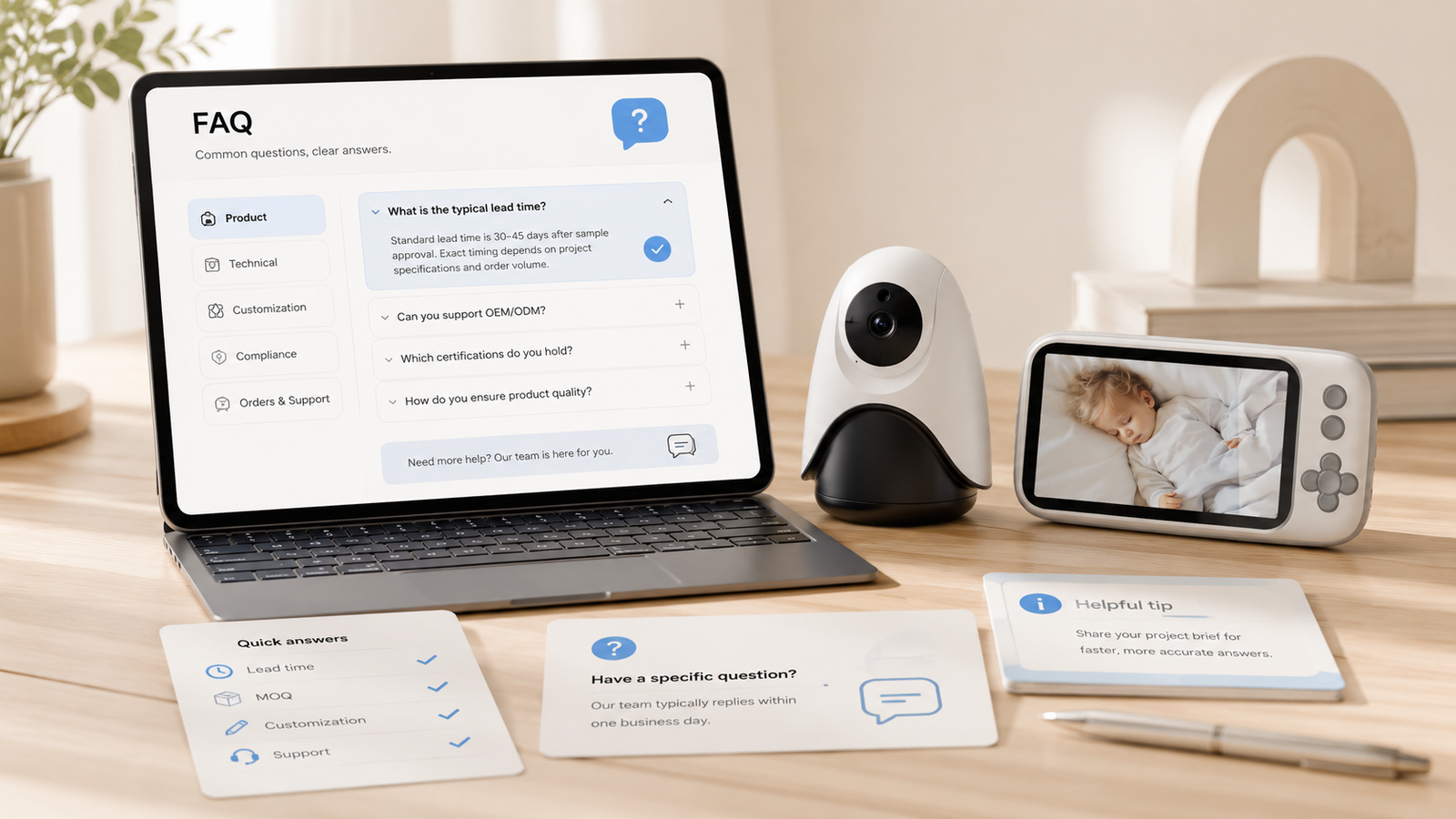
Frequently Asked Questions — before you send the RFQ
Straight answers on products, customization depth, samples and MOQ, certification, and order terms. If your question isn't here, it's a one-email answer away.
§01Products & Technology
What we build and how the no-WiFi architecture works.
What products does True Bond manufacture?
We are a Shenzhen-based B2B manufacturer of privacy-first, no-WiFi FHSS baby monitors for OEM, ODM, and private label programs. Our two current platforms are the TB-NW28 (2.8" parent unit, compact entry model) and the TB-NW50 HD (5" parent unit, 1280×720, split-screen capable). Both operate on a closed 2.4 GHz FHSS radio link — no app, no account, no cloud. See the full lineup on our products page.
What does "no-WiFi" actually mean — is it just marketing?
It's an architecture, not a label. The camera and parent unit form a closed point-to-point radio link using frequency-hopping spread spectrum: the video never touches a router, the internet, or a server, so there is no remote attack surface and nothing to set up. The full engineering explanation — including the FCC rules that govern FHSS — is in our article on how FHSS baby monitors work.
Can your monitors support multiple cameras on one parent unit?
Yes — the TB-NW50 HD supports multi-camera pairing with split-screen viewing on its 5" display, which is the typical configuration for two-child households and multi-room retail positioning. Camera counts, switching behavior, and display modes can be configured per ODM project; tell us your target use case and we'll confirm what the platform supports.
Do you also make WiFi / app-connected models?
Our current platforms are deliberately non-WiFi — privacy-by-architecture is our engineering focus and the positioning our partners build on. If your portfolio strategy calls for a connected line alongside a no-WiFi line, raise it in your RFQ and we'll discuss options openly, including when the honest answer is that another supplier fits that half of your portfolio better. Our comparison of FHSS vs WiFi vs DECT explains the tradeoffs.
§02OEM / ODM & Customization
How deep customization can go, and who owns what.
What's the difference between your private label, ODM, and OEM programs?
Private label: our existing product with your brand marks and packaging — fastest to launch. ODM: our proven platform customized for you — colors, housing options, firmware UI, feature mix, packaging. OEM: your design, engineered and manufactured by us — maximum differentiation, longest timeline. Most partners start at ODM. The full cost logic, including why MOQ scales with customization depth, is in our buyer's guide to OEM vs ODM.
What exactly can be customized?
In rough order of increasing depth: brand marks and retail packaging; housing colorways and surface finishes; firmware customization (boot logo, menu languages, default settings, feature enable/disable, alert behavior); custom housing geometry with new tooling; and full custom design. Each rung changes cost, timeline, and — for housing changes that affect the antenna — certification planning. We'll tell you which rung your differentiation goals actually require, including when the answer is a lower rung than you asked about.
Can I get my logo on the product with a small first order?
Typically yes — light customization (logo, packaging, manual) is the most MOQ-friendly rung of the ladder, and we structure first orders so new brands can test the market without overcommitting. Deeper customization naturally carries higher minimums, because tooling and setup costs need volume to amortize. Bring your realistic first-order quantity to the RFQ and we'll propose a configuration that works at that scale.
Who owns the certifications and tooling in a custom project?
That's a contract decision, not a default — and we put it in writing either way. Factory-held certification is faster and cheaper to launch with; brand-held certification costs more upfront and stays yours if you ever change suppliers. Tooling you fund can be contractually yours, with transfer rights documented. We walk every partner through this choice explicitly; the background is in our guide's section on certification and tooling ownership.
Do you support co-branding ("engineered by True Bond")?
Yes, and we like these arrangements: your brand leads on the shelf, our platform identity appears as the engineering credit, and in exchange the commercial terms typically improve — it's a structure that gives smaller brands committed engineering attention without paying for full exclusivity. Scope and placement of the credit are agreed per project.
§03Samples, MOQ & Ordering
Getting hardware in your hands, and what an order looks like.
How do I get a sample?
Request one through the contact / RFQ page with your company details and target market. Sample units of both platforms are available; sample and courier terms are confirmed at the time of request, and sample costs are commonly creditable against a subsequent order. Samples ship with the relevant spec documentation so your team can evaluate properly, not just unbox.
What is your MOQ?
Negotiable — deliberately. MOQ in this category isn't a fixed wall; it's a function of customization depth, because setup and tooling costs need volume to absorb them. Logo-and-packaging programs support meaningfully lower minimums than custom-housing programs. Tell us your realistic first-order volume and customization wishlist together, and we'll either confirm it works or show you which variable to adjust. The economics behind this are explained honestly in our OEM/ODM cost guide.
What payment terms do you accept?
Specific terms are agreed per order, but the typical structure is the industry-standard one: a deposit on order confirmation with the balance before shipment, via bank transfer (T/T). Alternative arrangements for larger or repeat programs are discussed case by case. Whatever is agreed goes into the proforma invoice explicitly — we don't do ambiguity around money.
What's the typical lead time?
Samples move in days to a couple of weeks depending on configuration. Production lead time depends on customization depth and quantity: light-customization orders are typically a matter of weeks after confirmation, while projects involving new tooling or firmware development run longer and are scheduled milestone by milestone. Every quote includes a concrete timeline for your specific configuration — and we'd rather quote a realistic date than a flattering one.
What should I include in my RFQ to get a fast, accurate quote?
Five things: target market(s), realistic first-order and 12-month volumes, desired customization level (logo-only up to custom housing), your launch date, and any certification-ownership preference. With those, we can usually return a configuration proposal and quote without a long back-and-forth. Send it via the RFQ form or directly to info@truebondtech.com.
§04Certification & Compliance
What your market requires, and how we plan for it.
What certifications does a baby monitor need for the US and EU?
In short: an FCC equipment authorization (FCC ID) for the US, and CE marking under the Radio Equipment Directive for the EU — plus battery transport testing (UN 38.3), substance compliance (RoHS/REACH), and national registrations like WEEE that land on the importer. The complete stack, including the obligations that are legally yours rather than the factory's, is mapped in our guide to FCC and CE requirements for importing baby monitors.
How do you handle certification for my branded version?
Certification is planned into the project timeline from day one, not bolted on at the end — and the certification route for your specific configuration and target markets is confirmed as part of the quote. Where you want to hold the grants under your own name, we structure the project that way; where speed matters more, we'll discuss the alternatives openly, including what each route means for you long-term.
What compliance documentation do you provide with orders?
A document pack aligned to your target markets and agreed in the contract — the goal is that your customs broker, freight forwarder, and marketplace onboarding never wait on paperwork. We encourage buyers to verify documentation independently (the FCC database is public, for example) and we explain how in our compliance guide's pre-deposit checklist. A supplier should welcome that verification; we do.
If I customize the housing, does the product need re-certification?
Possibly — and this is exactly why we plan it upfront. Cosmetic and branding changes generally don't disturb a radio approval, but changes to enclosure geometry or materials around the antenna can alter RF behavior and trigger re-evaluation. In our process, the certification impact of a housing change is assessed before tooling is cut, so the cost and timeline are known when you decide, never discovered after.
§05Shipping, Warranty & After-sales
After the goods leave the line.
What shipping terms (Incoterms) do you work with?
Common arrangements are EXW and FOB from South China, with other Incoterms discussable per order — and you're welcome to use your own freight forwarder. Battery-containing shipments are prepared with the transport documentation carriers require (including the UN 38.3 test summary), so your forwarder isn't chasing paperwork at booking time.
What warranty do you offer on OEM/ODM orders?
Warranty terms are agreed per contract, with coverage in line with category norms — a 12-month baseline is the common reference point in this industry, and longer arrangements are discussable for ongoing programs. What matters more than the headline number is what's written down: scope, claim process, and remedy (replacement units or credit) all go into the agreement explicitly before the first order ships.
How are defective units handled?
Two layers. Before shipment: every unit passes 100% functional, RF, and pairing testing, and each batch is sampled against AQL limits that can be specified in your purchase order — our testing walkthrough shows the full station-by-station process. After shipment: confirmed defects are handled through an RMA process agreed in the contract, typically via replacement units or credit on the next order, with failure analysis fed back into the line.
What's the fastest way to reach the team?
Email info@truebondtech.com or message us on WhatsApp at +86 135 1099 4408 — both reach the business development team directly, not a ticket queue. For project inquiries, the RFQ form is the fastest route to a structured quote. We respond within one business day.
Question not on the list?
Ask it directly — technical, commercial, or compliance. We'd rather answer a hard question before the deposit than an angry one after it.
Send your question or RFQ → info@truebondtech.com · WhatsApp +86 189 2846 4489 · Engineering blog for the deep answers